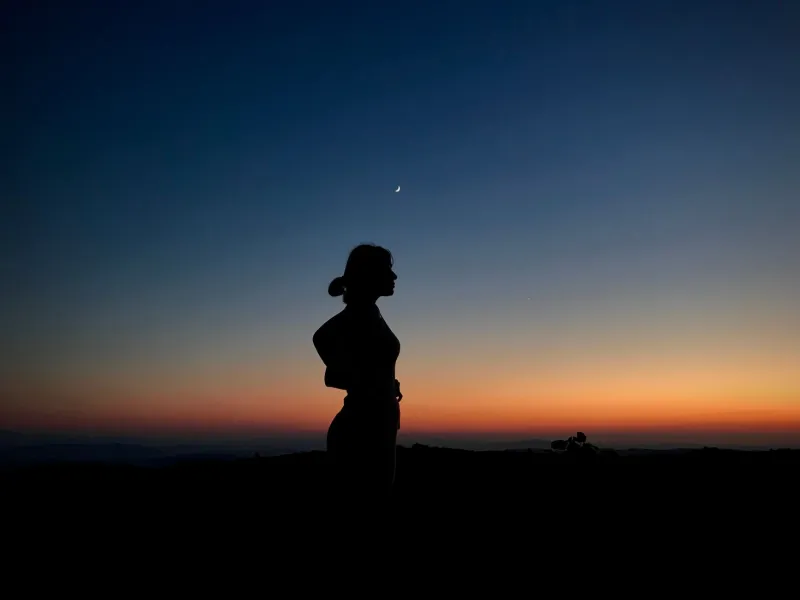
Stop Grinding Through the Dark: How the Moon Has Always Been Telling You to Rest

Somewhere along the way, American culture decided that rest was something you earned. You grind through the week, crash on Sunday, and call it recovery. Then you do it again. And again. Until your body starts sending louder signals — the 3 a.m. wake-ups, the cortisol that won't quit, the feeling that no amount of sleep actually restores you.
Here's what nobody in the productivity space wants to say out loud: rest isn't a reward. It's a biological requirement. And the moon — steady, cyclical, utterly indifferent to your to-do list — has been signaling exactly when to take it for thousands of years.
This isn't mysticism dressed up as self-care. It's the intersection of circadian science, traditional wisdom, and a nervous system that's begging you to stop treating rest like a weakness.
The Body Doesn't Run on a Linear Clock
We talk a lot about circadian rhythms — the 24-hour internal clock that regulates sleep, digestion, hormone release, and immune function. But the body also operates on longer biological cycles, and researchers are increasingly interested in what they call infradian rhythms: cycles longer than 24 hours that shape everything from mood to metabolism.
The lunar cycle — roughly 29.5 days — falls squarely into this territory. A 2021 study published in Science Advances found that human sleep patterns shift measurably across the lunar month, with people falling asleep later and sleeping less around the full moon, and experiencing deeper, longer sleep in the days surrounding the new moon. The researchers noted this held true even for participants in urban environments with zero exposure to natural moonlight.
Your body is already tracking the moon. The question is whether your schedule is letting it respond.
What Each Phase Is Actually Asking of You
Lunar phases aren't just poetic metaphors. They map onto genuine energetic and physiological shifts — and traditional healing systems from Ayurveda to Traditional Chinese Medicine (TCM) to Indigenous lunar calendars have documented these patterns for centuries.
New Moon: This is the biological exhale. Melatonin peaks, the nervous system naturally downshifts, and the body moves into repair mode. Ancient cultures across every continent treated the new moon as a time of withdrawal and renewal — not because they were being lazy, but because they were paying attention. This is your window for the deepest rest of the month. Honor it by scaling back your obligations, going to bed earlier, and letting your body do the quiet maintenance work it's been trying to do all month.
Waxing Crescent to First Quarter: Energy begins to build incrementally. Think of this less as a green light for full-on hustle and more as a gentle ramp. Your nervous system is coming back online. Rest here looks different — it's the kind of intentional stillness that lets new intentions take root without being immediately burned through.
Waxing Gibbous: The body is primed. Cortisol patterns support focus and output. This is genuinely a good time to push, to create, to act. But even here, the wisdom isn't to ignore rest — it's to make your recovery practices match the intensity. If you're training harder or working longer hours, your sleep needs to be equally robust.
Full Moon: This is where most people run into trouble. The full moon amplifies — energy, emotion, inflammation, insomnia. Research consistently links the full moon period to shorter sleep duration and lighter sleep architecture. Rather than white-knuckling through a productivity sprint, this phase calls for nervous system regulation: gentle movement, magnesium, screen-free evenings, and practices that discharge excess energy rather than add to it.
Waning Gibbous to Last Quarter: The moon is releasing, and so can you. This is a physiologically supportive time for detoxification, lymphatic movement, and letting go of what accumulated during the peak. Rest here has a specific quality — it's less about sleep duration and more about slowing the pace of your days.
Balsamic Moon (the final days before the new moon): This is the liminal zone, and it's one of the most underrated rest windows in the entire cycle. Fatigue is common, motivation often dips, and the immune system is doing heavy lifting. Many healers and traditional practitioners consider these days sacred for withdrawal. If you've been pushing hard all month and you feel depleted right now, this is not a personal failure. It's a phase.
What Burnout Actually Is (Through a Lunar Lens)
Burnout isn't just about working too many hours. It's what happens when you repeatedly override your body's signals for rest — when you treat every phase of the month like it's the waxing gibbous and wonder why you're running on empty by Thursday.
From a nervous system standpoint, chronic overriding of rest cues keeps the body locked in sympathetic activation — the fight-or-flight state that was designed for short-term emergencies, not a permanent operating mode. Over time, this depletes cortisol reserves, disrupts sleep architecture, impairs immune response, and disconnects you from the intuitive signals your body is trying to send.
The moon doesn't ask you to be less ambitious. It asks you to be rhythmic. There's a difference.
Building a Lunar Rest Practice (Without Overhauling Your Life)
You don't need to quit your job or clear your calendar to start working with lunar rest cycles. You need a few anchor points.
Track the phases. You can use a moon phase app, a lunar calendar, or just bookmark a reliable site. Awareness is the first practice.
Identify your two deepest rest windows each month. For most people, that's the new moon and the balsamic phase. Put them in your calendar the way you'd schedule a workout or a work deadline. Protect them.
Adjust your sleep hygiene to match the phase. Around the full moon, prioritize nervous system wind-down rituals — think cool room, no news after 8 p.m., magnesium glycinate, and a sleep mask. Around the new moon, let yourself go to bed earlier without guilt.
Stop moralizing rest. This is the cultural work. Every time you catch yourself thinking I'll rest when I'm done or I don't have time to slow down, notice it. That thought is a product of a culture that profits from your exhaustion. The moon doesn't care about your productivity metrics. Your body doesn't either.
The Radical Act of Listening
There's something quietly revolutionary about choosing rest in a culture that glorifies grinding. But it's not passive. Intentional lunar rest is a practice — it requires attention, consistency, and the willingness to trust that slowing down in the right moments actually accelerates healing over the long arc.
The moon has been cycling through these phases for 4.5 billion years. Your nervous system evolved alongside that rhythm. The signals have always been there.
Maybe it's time to finally pick up the phone.