Grief Has No Finish Line — But the Moon Can Show You Where You Are
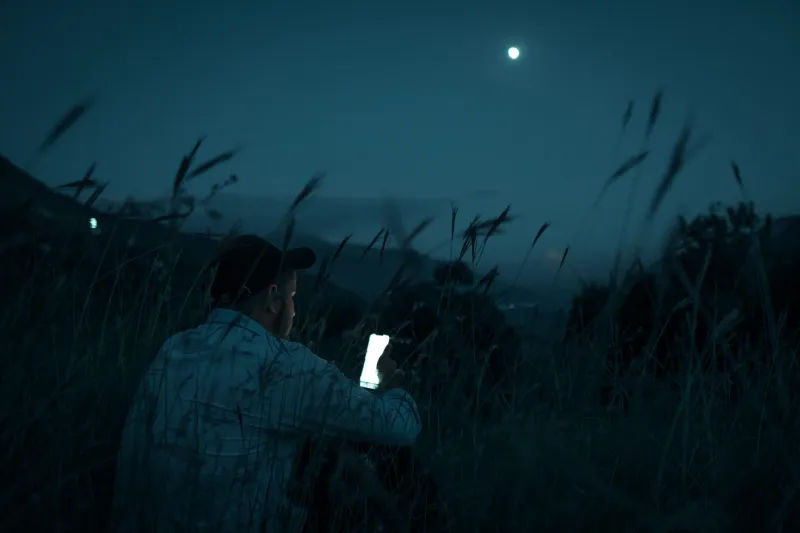
Somebody probably handed you the five stages at some point. Maybe a well-meaning friend texted them. Maybe a therapist printed them out on a laminated sheet. And maybe — like a lot of people — you stared at that list and thought, I don't feel like I'm doing this right.
Here's the thing: you are. You're just not doing it on the calendar grief culture invented.
Grief is not linear. It doesn't clock out on a Tuesday after six months because the books said so. And for a growing number of somatic practitioners, grief counselors, and people simply trying to survive loss, the moon's cyclical nature offers something the Kübler-Ross model never quite could — permission to keep circling back without feeling like you've failed.
Why the Stages Model Falls Short for So Many People
Elisabeth Kübler-Ross gave us a language for grief, and that was genuinely valuable. But she also — somewhat famously — noted later in her life that her model was never meant to be a rigid timeline. It was meant to be descriptive, not prescriptive. Somewhere along the way, American culture turned it into a checklist.
The problem with checklists is they make grief feel like a project you can complete. And when you hit month seven and you're still not "at acceptance," the checklist becomes another thing to feel bad about.
Lauren Whitfield, a grief counselor based in Asheville, NC, who incorporates somatic and nature-based practices into her work, puts it plainly: "I've had clients come in convinced they were grieving wrong because they felt fine for three weeks and then completely fell apart on what would have been their mother's birthday. That's not regression. That's grief being human."
What Whitfield and practitioners like her are increasingly finding is that offering clients a cyclical framework — rather than a linear one — shifts the entire emotional experience. "When someone understands that feeling raw again doesn't mean they're back at square one, everything softens," she says. "The moon is one of the most accessible teachers of that lesson."
The New Moon: When Grief Goes Quiet (and That's Okay)
The new moon is dark. It asks nothing of you visually — no brightness, no pull toward expansion. For people in grief, this phase can mirror the moments when loss seems to go underground. You're not crying at the grocery store. You're just... numb, or busy, or somehow okay.
This isn't denial. It's integration happening below the surface.
Somatically, the new moon is a natural window for stillness and inward rest. If you're grieving, honoring this phase might look like giving yourself explicit permission to not process — to just exist without performing your healing for anyone, including yourself. Journal prompts that work here tend to be gentle: What am I carrying right now that I don't need to examine yet?
The Waxing Phases: When Grief Starts Asking Questions
As the moon builds from crescent toward full, there's a natural energetic uptick — and grief often rides that wave in complicated ways. This is frequently when the "why" questions surface. Why did this happen? What did I miss? What comes next for me?
Marcus Delray, a somatic therapist in Portland, OR, who works with bereaved clients, describes this phase as "the grief that wants to be witnessed." In his practice, he encourages clients to notice when they feel a pull toward talking, writing, or moving their body more — and to recognize that as part of the waxing moon's amplifying energy rather than a sign that something is wrong.
"A lot of people feel guilty when they have a burst of energy during grief, like they should still be on the floor," he says. "But the body is cyclical. Honoring the waxing energy doesn't mean you've forgotten your loss — it means you're alive."
This is also the phase where many people feel drawn to ritual: lighting a candle, revisiting photos, writing letters to the person or thing they've lost. That impulse is worth honoring.
The Full Moon: The Wave Crest You Didn't See Coming
If you've ever had a grief surge out of nowhere — one that felt disproportionate to whatever triggered it — there's a good chance it happened near a full moon. The full moon amplifies emotional energy across the board, and grief is no exception.
This isn't woo-adjacent speculation. Research has long explored the relationship between lunar cycles and emotional regulation (including studies on hospital admissions and mood fluctuations), and while the science is still evolving, the anecdotal evidence from practitioners is consistent: the full moon brings things up.
For grievers, this can feel terrifying — like being knocked backward. But reframing the full moon surge as a release rather than a relapse changes its meaning entirely. The wave crests, and then it recedes. You don't have to white-knuckle your way through it. You can breathe into it, cry through it, call a friend, take a bath, scream into a pillow — and know it will pass.
Whitfield recommends what she calls a "full moon grief window" — a 24 to 48-hour period around the full moon where her clients give themselves explicit permission to feel whatever comes up without judgment or agenda. "It's not about manufacturing grief," she clarifies. "It's about not being surprised when it shows up, and not fighting it when it does."
The Waning Moon: The Long Exhale
The waning phases — gibbous, last quarter, balsamic — are where a lot of the quiet, unglamorous work of grief actually happens. The emotional intensity of the full moon has peaked. Now comes release, reflection, and the slow metabolizing of what you've been carrying.
This is often the phase where people feel ready to sort through belongings, have hard conversations, or revisit memories they'd been avoiding. It's not that the grief is gone — it's that the waning moon offers a kind of emotional exhale that makes it more bearable to look directly at things.
Delray describes the waning moon as "the phase where integration lives." In somatic terms, this is when the nervous system has a chance to process what the full moon stirred up. Gentle movement, breathwork, and time in nature tend to feel especially supportive here.
Building Your Own Lunar Grief Map
None of this is about forcing your grief into a new framework. The moon isn't a replacement for therapy, community, or time. But it is a remarkably honest mirror — one that never tells you you're behind.
If you want to start working with the lunar cycle as a grief companion, here's a simple starting point:
- Track your emotional weather alongside the moon phase for one full cycle (about 29 days). You don't need to analyze it — just notice.
- Name what phase you're in internally, not just astronomically. Are you in a new moon period of your grief — quiet and still? A waxing phase of questions? A full moon peak of intensity?
- Release the finish line. Grief cycles back. So does the moon. Neither one is broken for doing so.
Your healing timeline is yours. It doesn't have to match your sister's, your therapist's chart, or the cultural script that says you should be "moving on" by now. The moon has been cycling through loss and renewal for longer than any of us have been here — and it has never once apologized for repeating itself.
You don't have to either.